Management
Design and engagement in times of war

<first>T<first> he role of Design Manager can be summarized as follows: amplifying the impact of Design through the team’s outcomes. In practice, this involves a wide range of responsibilities, including setting quality standards for execution, translating the company’s strategic context into actionable direction for the team, crafting a vision for product evolution, and supporting each team member’s individual development. But to effectively unfold this, the manager has the foundational responsibility to maintain a stable level of team engagement over time. Without this, all other duties risk becoming irrelevant.
Since 2022, nearly all tech companies have faced instability due to macroeconomic shifts. The term “wartime” became a familiar label for a cycle marked by high inflation and limited access to investment. This period posed significant challenges for Design leadership. Team downsizing and ongoing restructuring had a direct impact on motivation. In parallel, internal engagement surveys became valuable management tools, providing tangible data to help assess how these changes were affecting the company’s day-to-day dynamics.
Understanding the external context
It’s challenging to discuss engagement in Design teams from 2023 to 2025 without examining the preceding years. Between 2016 and 2020, the market experienced a period of low inflation and greater access to venture capital [1]. During that time, there was an intense cycle of startup maturation. With more funding available and a pressing need to build out teams, Design leaders were primarily focused on the challenges of hiring. The pandemic, the rapid digitalization of services, and the rise of remote work only intensified the competition for talent and the drive for accelerated growth, at least initially.
Fast forward to 2022, and the landscape has changed dramatically. The onset of the war in Ukraine, combined with the lingering inflationary effects of the pandemic, ushered in a cycle of instability for tech companies. Investors—once eager to take risks—grew cautious in the face of uncertainty. Startups, especially those heavily reliant on capital, found themselves in vulnerable positions. Design leaders saw their roles shift: instead of hiring, they were now tasked with restructuring their teams to reduce costs. In practice, “restructuring” often became synonymous with layoffs.
Alice was no exception. We were in a very strong position up until the end of 2021. In December of that year, we completed our Series C funding round, bringing in R$728 million. This investment enabled Alice to outline an ambitious expansion plan across multiple teams and squads. The Design team grew rapidly as part of this strategy, especially to support the expansion of services into the B2B market. However, with the economic landscape shifting in 2022, we entered an inevitable cycle of restructuring. This complex transition had a direct impact on the team’s dynamics and engagement.

Measuring engagement at Alice
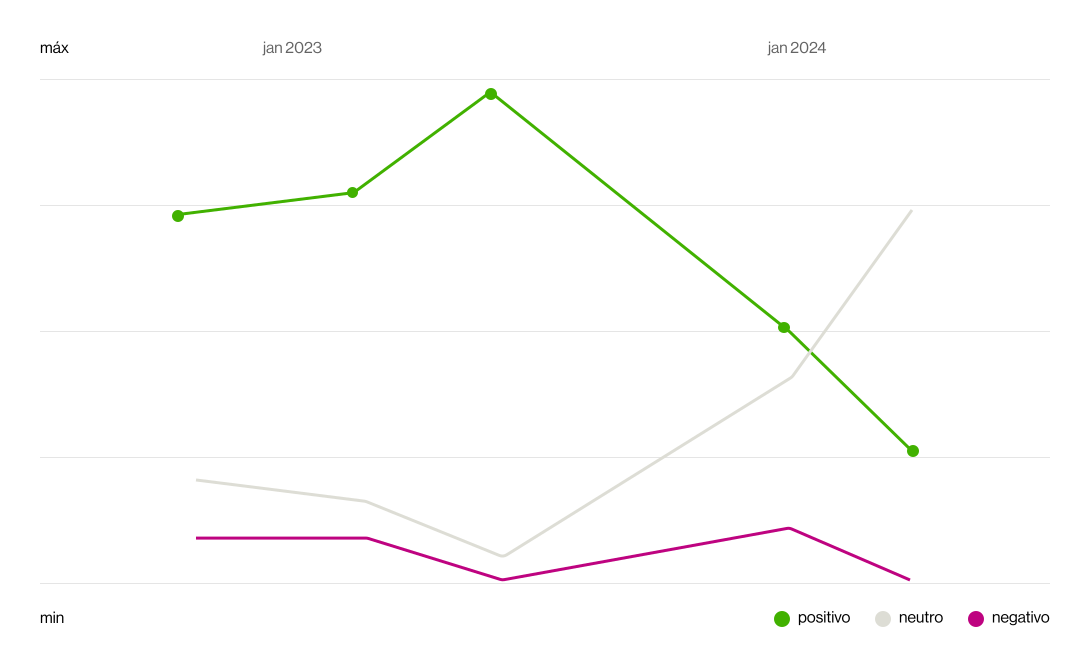
At Alice, we run an engagement survey every three months to help gauge employee motivation. It consists of a questionnaire that evaluates several criteria, including recognition, trust, compensation, work-life balance, and impact. Based on the responses, each team receives a score from 0 to 100. This provides a clear, objective indicator that’s easy to communicate and helps assess the current state of each team. Additionally, this quantitative view enables straightforward comparisons across different departments, as well as benchmarking Alice against similar companies.
As a result of the broader economic instability, we observed a sharp drop in engagement levels within the Design team, particularly in the Revenue and Insurance tribes. In January 2024, we recorded our lowest score to date, with an uncertain outlook ahead. Our initial hypothesis was that the ongoing structural changes had weakened the team’s sense of identity. At that point, the issue became urgent for us as Design Managers. In a wartime scenario, how could we rebuild team motivation and reverse this trend?
A Design process for engagement
At first glance, our goal might have seemed like a purely quantitative effort to reverse the results of the engagement survey. However, in our Design Managers’ forum, we recognized that such a solution would be incomplete—perhaps even superficial. The real question was much deeper: how could we foster genuine commitment and emotional safety, rather than inadvertently encouraging a performative display of motivation? [2] For managers with different styles and backgrounds, this was a unique and formative shared learning experience. Working with a woman leader was particularly important during this time, as it helped me shape a more diverse and holistic perspective on the problem.
Along the way, we emphasized the importance of contextual understanding as the foundation for analyzing employee engagement, especially during a period of job insecurity. In our view, motivation couldn’t be treated as an isolated state that fluctuated every three months. Rather, it should be seen as the outcome of activities discussed and nurtured in the periods between those measurement points. The engagement score shouldn’t be the end goal, but a reference point for the actions to improve the team’s experience. From there, we designed a broader process to reflect on and actively promote greater engagement among designers.
While working with the Revenue and Insurance tribes, I focused on three key experiments: qualitative deep dives, business literacy, and Design Principles. Through these activities, I collaborated with other managers to monitor the progression of overall engagement data over time.
Qualitative deep-dive
In times of economic instability and uncertainty, people may feel uncomfortable opening up on their own. This can make engagement harder to interpret clearly. That’s why it became crucial to create safe, more intimate spaces where the team could speak freely about critical issues. With that in mind, we launched an initial set of small-group workshops for open discussions about the survey results. These sessions were held monthly, establishing a continuous feedback loop that filled the gap between the quarterly surveys.
The sessions were centered around five key questions: (a) How would you describe the current team atmosphere?; (b) Is there anything you’ve wanted to say but haven’t had the chance to?; (c) What should we prioritize now to support the team’s well-being?; (d) What kind of support or resources would be most useful to you right now?; (e) In one sentence, how would you describe a safe and engaged team?
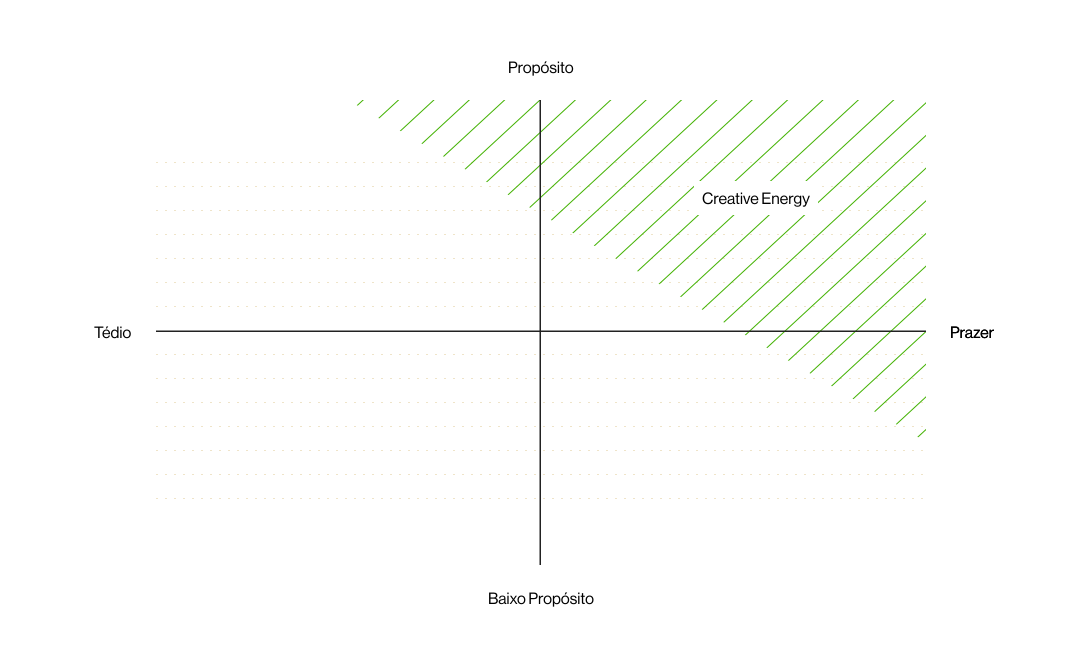
At the same time, each person was invited to complete a creative energy map identifying the activities that created the greatest sense of purpose and flow, as well as how frequently those activities occurred [3].
By intentionally deepening the context—with more time and closeness—these methods helped reveal the “why” behind the numbers (qualitative) to complement the overall engagement score (quantitative). More broadly, these exercises also supported the collective development of vulnerability; in other words, the courage to speak honestly during a time of uncertainty [4]. Throughout the process, we aimed to observe how each action could strengthen team relationships, build resilience, and ultimately influence the broader perception of engagement.
Business literacy
Alice follows a unique transparency policy. Every month, the team responsible for monitoring financial results (P&L) meets with the company leadership—including Design Managers—to share a detailed breakdown of the previous month’s numbers. These meetings cover key items, such as revenue, growth, costs, margin, runway, and monthly burn rate. This level of openness is a bold move for any company. The goal is twofold: to communicate the business’s overall health and ensure that every Manager has enough context to lead their teams and share that understanding.
As Design Managers, our role was to translate this information into clear and accessible language. This helped level the playing field for designers with different backgrounds and varying tenures at the company. We used a straightforward format: the seven key points the team needed to understand Alice’s business context each month. We also introduced practical analogies to make the data easier to digest. For example, when breaking down acquisition costs and terms like CAC, SQL, and CPL, we relied on familiar team experiences, such as online shopping.
In uncertain times, there’s a natural tendency to lean into artificial optimism out of fear of demotivating the group, but it was important to face that fear and communicate the numbers as they truly were [5]. We observed that keeping our approach transparent and straightforward, the team felt empowered to ask bold questions and dig deeper into the data. In our conversations, we explored whether this clarity could reduce speculation, help contextualize difficult decisions, and foster a sense of shared responsibility. The process also helped bridge the gap between Design Managers and leaders in Alice’s financial teams.
The true value of the survey lies in using it as a starting point, not an end. It should create space for genuine conversations and a deeper understanding of the context.
Design Principles
In 2022, during a period of team growth, we ran co-creation sessions to define our Design Principles and took advantage of the arrival of new team members, who brought fresh and diverse perspectives, to build a shared vision for the Design Chapter. The outcome would serve as a practical guide for anyone on the team to use in their day-to-day work. Through this exercise, we defined five core concepts: create the new, care, build together, delight, and be resolute. As managers, we saw this approach as a way to support team cohesion and resilience amid restructuring and personnel shifts.
The principles were validated during weekly Design meetings. Each week, teams would present the progress of their work across the different Alice tribes. In addition to showcasing interfaces, the presenters were asked to connect their initiative to the principle most clearly reflected in the solution. This practice gave visibility to each Designer’s work, functioning as a platform to highlight and celebrate achievements. It directly supported an important criterion in the engagement survey: recognition—the feeling that their contributions were seen and valued.
In particular, we also examined whether being resolute had a distinct effect in wartime. This principle was closely tied to the notion of impact, in other words, the sense that their work creates real value and contributes to Alice’s success. To give a concrete example, the team was improving the experience for HR clients at Alice, who originally used a single metric (CES) as input for enhancements to the HR benefits platform. As they evolved, they prioritized a broader set of product usage metrics to support the roadmap with greater objectivity. In their weekly presentation to the Design Chapter, the principle of being resolute was used to frame that decision.
Despite the ongoing structural changes, the five principles defined in 2022 remained a consistent point of reference throughout 2023 and 2024. We tracked the ones that showed up most often in presentations and questioned whether they remained relevant. We also explored whether they helped unify the team’s perspective by linking different initiatives to shared concepts. Our hypothesis was: yes—rituals have power. [6]

Engagement as a collective phenomenon
Considering the engagement curve within Design, two conflicting thoughts are necessary. On one hand, our ability to reverse a sharp drop in the metric; on the other, the possible gap between a demonstration of engagement and the actual feeling behind it, especially in times of uncertainty. Still, I believe this data was a catalyst for bringing the team closer together. It pushed me to examine a complex problem through a contextual and systemic lens, rather than a purely quantitative or individual one. In a unique wartime moment, this process allowed us to move forward as a resilient and adaptable group.
What will be the role of a Design Manager in the years ahead? Reflecting on how the Design discipline has evolved, this experience may offer useful insights for other leaders. At Alice, we were able to enhance human conversations while navigating moments of intense instability. In the present and near future, as artificial intelligence plays a growing role in team dynamics, new variables will shape how people experience engagement, and by recognizing team motivation as a multifaceted phenomenon shaped by a broader socioeconomic context, Design Managers will be better equipped to lead in an era of uncertainty.

References
1. BC eleva Selic em 0,25 ponto, a 15% ao ano. Folha de São Paulo (2025)
2. The repressive politics of emotional intelligence. Merve Emre, The New Yorker (2021)
3. Creative energy worksheet. Dropbox (2019)
4. Dare to lead. Brené Brown, Random House (2018)
5. The hard thing about hard things. Ben Horowitz, Harper Business (2014)
6. The making of a manager. Julie Zhuo, Portfolio (2019)


